
The Secret Culprit Behind Your Neck and Shoulder Pain: A Guide to First Rib Mobilization
By Personalized Physical Therapy and Wellness
Have you ever experienced mysterious neck or shoulder pain, tension headaches, or even tingling and numbness running down your arm? You might be surprised to learn that an often-overlooked culprit behind these issues is your very first rib. As a common contributor to decreased range of motion and upper-body discomfort, first rib dysfunction is something physical therapists see frequently. Let’s dive into what the first rib is, why it misbehaves, and how physical therapy—specifically first rib mobilization—can help you find relief.
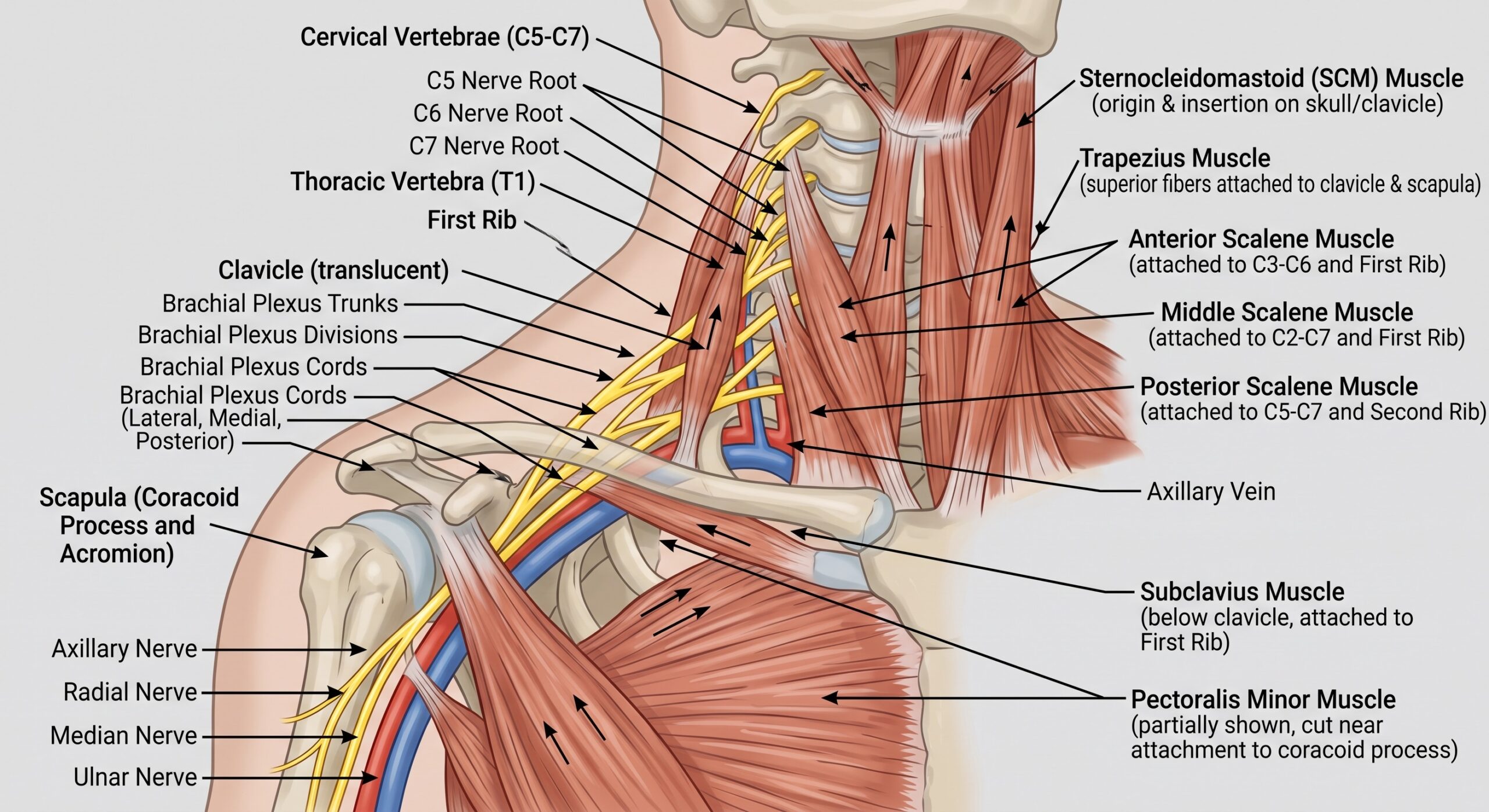
A Look at the Anatomy: Finding the First Rib
To understand the root of the problem, we first need to look at the anatomy.
(Image Focus: Diagram of the human ribcage highlighting the First Rib) As you would see in an anatomical diagram of the ribcage, the human body features 12 pairs of ribs separated by intercostal spaces. The first seven ribs gradually increase in length, while the lower five begin to decrease. The first rib sits at the very top of this structure. It is considered an atypical rib because it is shorter and structurally different from the rest. You can actually locate it on your own body: simply press down through your upper trap muscle, just behind your collarbone (clavicle), right close to your neck.
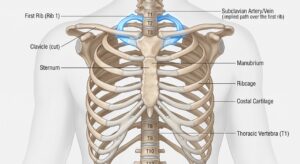
(Image Focus: Diagram of the neck and shoulder showing Muscle Attachments and Nerve Bundles) Looking closely at the muscle attachments in the upper chest and neck, it becomes clear that the first rib is a relatively unstable structure. It serves as a crucial attachment site for several muscles, most notably the scalenes. The real trouble begins when this first rib becomes elevated. When elevated, the rib pushes up and compresses the Brachial Plexus—a vital nerve bundle responsible for sending sensation down to your arm and hand—along with the arteries and veins that run between the clavicle and the first rib. This specific compression is exactly what causes symptoms to radiate down your arm.
An elevated first rib can happen for several everyday reasons, including:
-
Physical trauma, such as the impact from a car accident
-
Poor daily posture
-
Repetitive motions
-
Consistently sleeping on your stomach
How Physical Therapy and Mobilization Can Help
If it is established that you have an elevated first rib, your physical therapist will step in to create a comprehensive rehabilitation plan. First rib dysfunction can be highly treatable. The core goal of physical therapy here is to use first rib mobilization techniques to reduce or entirely eliminate your pain.
First rib mobilization focuses on improving the mobility and resting position of the rib itself. By properly repositioning it, the therapy alleviates the irritation placed on those underlying nerves and blood vessels. To achieve this, physical therapists utilize a variety of modalities:
-
Muscle energy techniques or direct manual manipulation
-
Dry needling
-
Targeted physical therapy stretching encompassing the chest, neck, and shoulders
Self-Mobilization Exercises for Home
Alongside hands-on physical therapy, your therapist will guide you through special exercises to alleviate symptoms. Here are some of the most common and effective movements you can perform:
-
Using a ball: While keeping your back straight, press a therapeutic or lacrosse ball into your shoulder, placing it as close to your neck as possible. Push as strongly as you can comfortably bear. This motion helps increase the space between the clavicle and the first rib, where compression most often occurs. Hold the position for 30 seconds and repeat 2-3 times.
-
Pulling apart a resistance band: Stand upright while holding a resistance band in each hand. Initiate the pulling motion using your shoulders and shoulder blades. This effectively stretches your chest and back, which is incredibly beneficial if you sit a lot during the day.
-
Chin tuck: Sit upright in a chair and gently tuck your chin toward the front upper part of your neck. You should feel the front neck muscles activate while experiencing a stretch in the back of the neck. Make sure not to push too hard or move your neck excessively.
-
Cow-Cat stretch: Recommended by Physiopedia, start on your hands and knees with your knees under your hips and hands under your shoulders. Inhale, arch your back, press your chest toward the floor, lift your head up, and point your sit bones to the ceiling (cow). Then inhale, round your back outward, pushing your shoulder blades away to form a “C” curve in the opposite direction (cat). Repeat this ten times.
-
Diaphragmatic Breathing: This is a simple yet highly effective first rib self-mobilization technique. Lie down on your back, placing one hand on your stomach and the other on your chest. Breathe deeply into your stomach so that your belly rises, but actively ensure your chest and ribs stay entirely in place.
If you are currently experiencing these frustrating symptoms or fall into the risk group for first rib dysfunction, minor lifestyle changes can also speed up your recovery. It is highly recommended to stop carrying heavy bags over your shoulder, watch your weight, and avoid repetitive movements and lifting heavy objects. All of these daily habits can dramatically increase the pressure on your thoracic outlet, hindering your progress.